

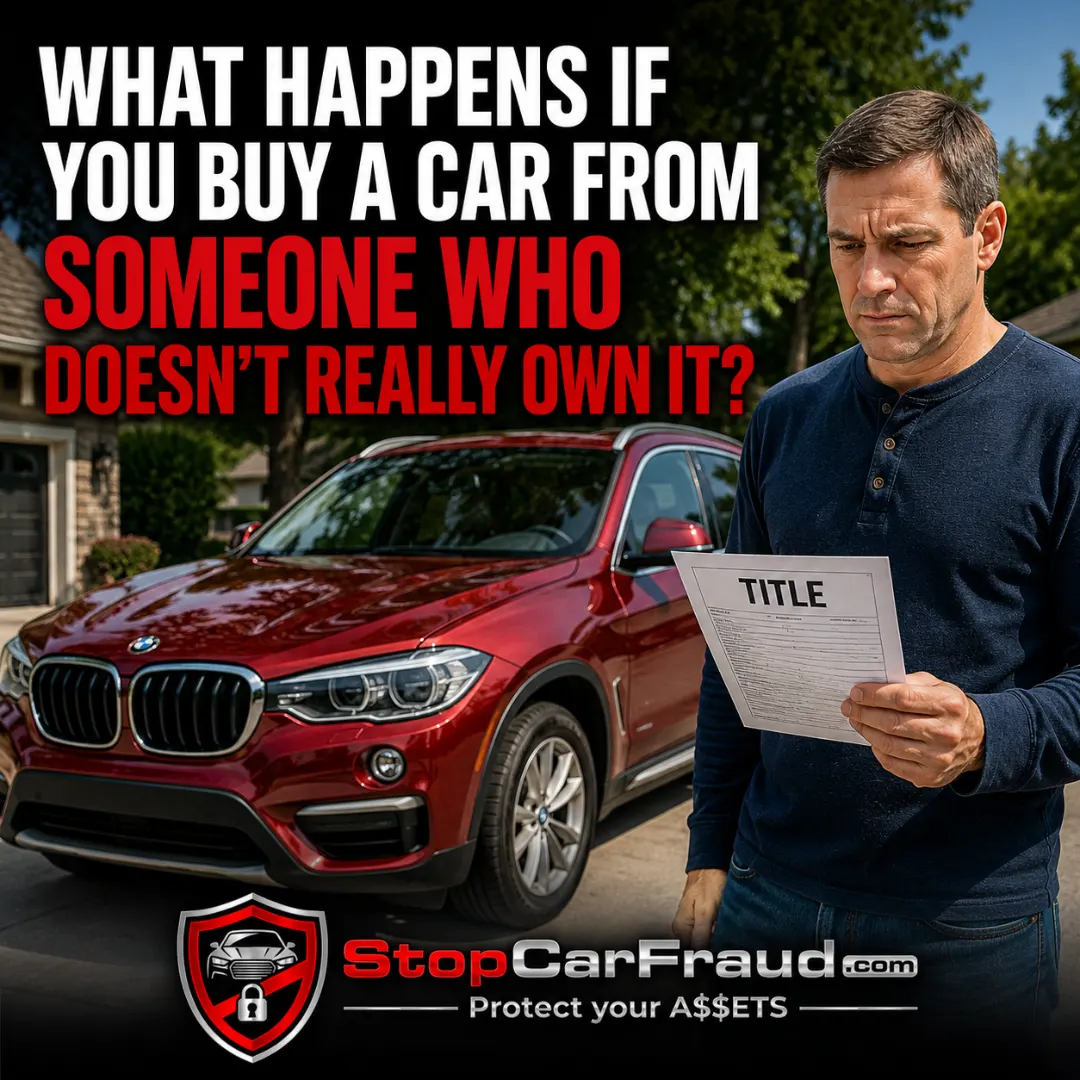
YOU PAID FOR THE CAR. YOU HAVE THE KEYS. BUT IT MAY NEVER LEGALLY BE YOURS.
You found the car. You inspected it. The price was right. The seller handed you the keys, signed some paperwork, took your money and watched you drive away.
Congratulations!! You bought a car. Or did you?
One of the nastier problems in used-vehicle transactions has nothing to do with whether the engine runs, the mileage is accurate or the vehicle has been wrecked. The problem may be the person who sold it to you.
What if that person didn't actually have the legal right to sell the vehicle?
Possessing a vehicle isn't the same thing as proving legal ownership. Having the keys certainly isn't. And even producing what appears to be a legitimate title doesn't necessarily settle the question of whether the person standing in front of you has the authority to transfer that vehicle.
That's why verifying a used vehicle shouldn't stop with checking the VIN and looking at a vehicle-history report.
The Car Can Be Real. The Paperwork Can Look Real. The Sale Can Still Be Wrong.
There are numerous ways ownership problems can hide behind an otherwise ordinary vehicle transaction.
A seller might have purchased the vehicle previously but never properly transferred the title into their own name, a practice commonly known as title jumping. Someone could present paperwork containing an unauthorized or forged signature. Another person may claim to be selling the vehicle for the owner under a power of attorney. Vehicles belonging to deceased owners can involve estate or inheritance requirements before ownership can legally be transferred.
Then there are liens. Someone can physically possess a vehicle, drive it every day and have the keys sitting on the kitchen counter while a lender or another party still has a recorded financial interest in it. That is why the person, the vehicle and the paperwork all need to tell the same story.
WHAT YOU SEE vs. WHAT YOU ACTUALLY NEED TO KNOW
| What Looks Reassuring | What You Still Need To Know |
|---|---|
| Seller has the keys | Does this person legally own the vehicle? |
| Seller produces a title | Whose name is actually on it? |
| VIN matches the vehicle | Does it also match all ownership documents? |
| Seller says they're selling for someone else | What gives them authority to sell it? |
| Seller produces a power of attorney | Is it valid for this transaction? |
| Seller says the loan is paid | Has the lien actually been released? |
| Seller wants payment immediately | Why can't ownership be verified first? |
"But I Have The Title!"
And that's where things can become expensive.
A title can look perfectly convincing to an ordinary buyer. The problem may not become apparent until that buyer attempts to transfer ownership and register the vehicle. Depending on the circumstances, questions involving another owner, a lienholder, an estate or questionable documentation can suddenly stop what appeared to be a routine transfer.
Meanwhile, the seller already has the money. Federal consumer guidance recommends obtaining a vehicle-history report before purchasing a used vehicle. These reports can provide valuable information involving title history, ownership history, salvage status, insurance losses and other events.
But here's the important part: A Vehicle-History Report Investigates The Car. It Doesn't Automatically Verify Every Person And Document In The Transaction.
That's a critical distinction. A perfectly real vehicle can still become part of a questionable or fraudulent transaction.
Don't Just Verify The Car. Verify The Right To Sell It.
Before handing someone thousands—or tens of thousands—of dollars, ask more than, "Is this a good car?"
Who actually owns it? Does the seller's identity correspond with the ownership documents? Is there a lien? If somebody else is selling it, what gives that person authority to do so? Do the VIN, title, seller and supporting documents all make sense together?
If they don't, stop the transaction until you understand why. Because discovering that you bought a car with a bad transmission is expensive.
Discovering that the person who took your money may never have had the legal authority to sell you the vehicle in the first place can become an entirely different nightmare.
StopCarFraud: Verify Before The Money Changes Hands
If something about a vehicle's title, ownership, lien release, seller identity or transaction doesn't make sense, don't guess and don't ignore it. If you are unsure about a lien release or vehicle transaction, contact StopCarFraud at info@stopcarfraud.com.
Research Sources / Footnotes
1. Federal Trade Commission — Used Cars / Consumer Advice. FTC consumer guidance recommends obtaining a vehicle-history report and explains that reports may contain ownership history, accident information, salvage information and other vehicle-history data.
2. Federal Trade Commission — Used Car Rule. Federal guidance concerning information and disclosures involved in used-vehicle sales, including the recommendation that consumers obtain vehicle- history reports.
3. California Department of Motor Vehicles — Title Transfers and Changes. DMV guidance provides examples of different ownership-transfer situations, including private sales, lien payoffs, estates, inheritance and deceased-owner transfers, illustrating why the documentation required can depend on who legally owns the vehicle and the circumstances of the transfer.
State title, lien and vehicle-transfer requirements vary, so specific transactions should also be checked against the applicable state's DMV and laws.