

WHEN EVERYTHING CHECKS OUT—UNTIL YOU CHECK ONE LEVEL DEEPER.
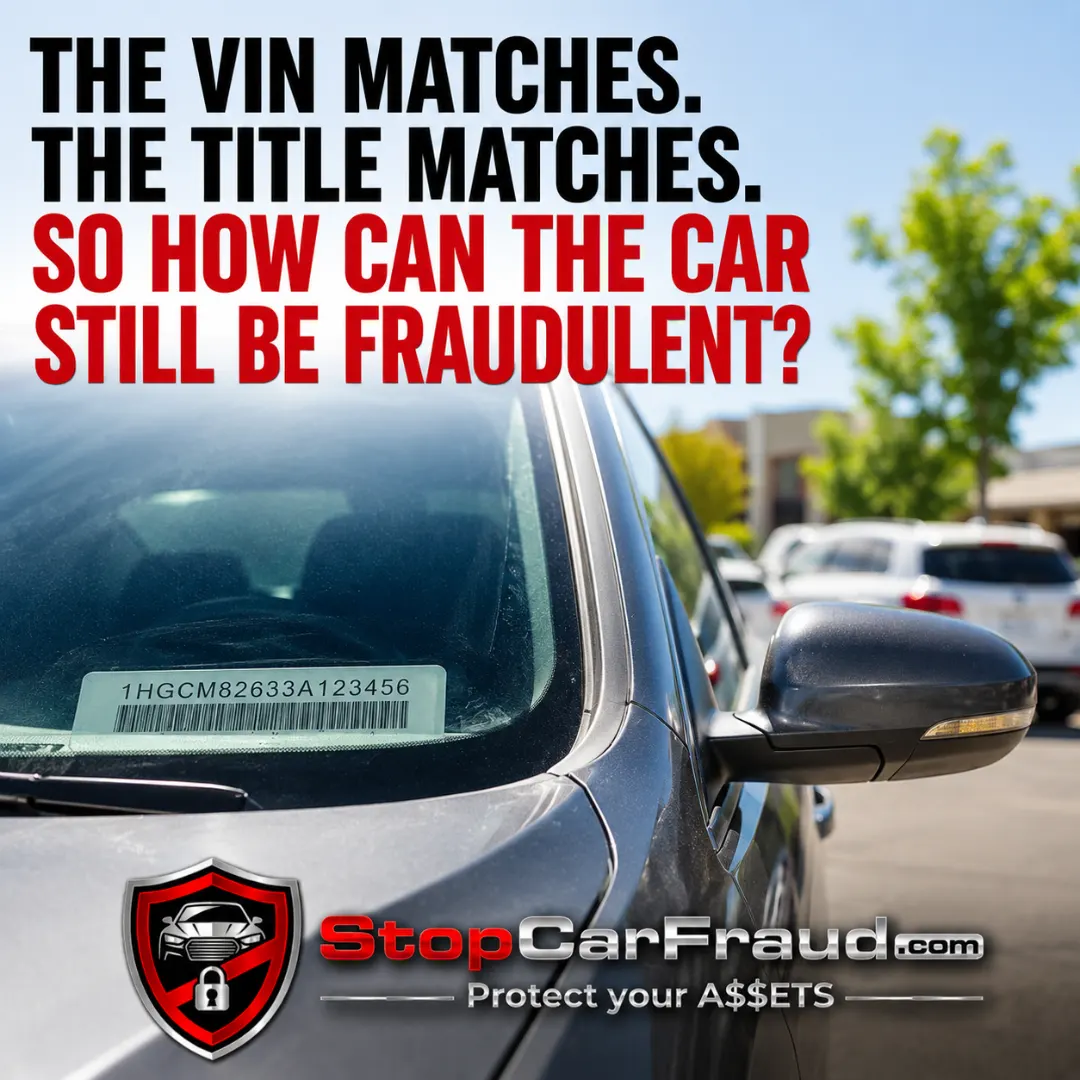
You found the vehicle you wanted. The price is good. The seller has the title. You look through the windshield and check the Vehicle Identification Number.
The VIN on the car matches the VIN on the title.
Great. Everything checks out...except there could be another vehicle hundreds of miles away carrying the exact same VIN. Welcome to the world of VIN cloning, where checking the number is important— but checking the wrong vehicle identity perfectly doesn't protect you from fraud.
How Do You Clone A Car's Identity?
VIN cloning is essentially automotive identity theft. The National Insurance Crime Bureau warns that criminals can copy the VIN from a legitimate vehicle and use it to disguise the identity of a stolen vehicle of the same or similar make and model. Counterfeit VIN tags and fraudulent ownership documents can then be created around that stolen identity.
That's what makes this type of fraud particularly dangerous. The criminal doesn't necessarily need to give you a VIN that produces a giant flashing STOLEN VEHICLE warning. Quite the opposite.
The whole point is to give you a VIN that looks legitimate.
You run the number. The vehicle description matches. You inspect the title. That number matches too.
You may even obtain a vehicle-history report.
Meanwhile, you could be researching the history of the real vehicle whose identity was stolen, rather than the physical vehicle sitting in front of you.
EVERYTHING MATCHES... SO WHAT COULD STILL BE WRONG?
| What You Checked | What Could Still Be Happening |
|---|---|
| VIN matches the title | Both may be part of the same false identity |
| VIN identifies the correct make/model | VIN may have been copied from a similar legitimate vehicle |
| Vehicle history looks clean | History may belong to the legitimate vehicle |
| Title looks authentic | Fraudulent ownership documents can accompany VIN cloning |
| VIN plate looks normal | A counterfeit VIN tag may have replaced the original |
| Seller has registration paperwork | Documentation alone may not establish the vehicle's true identity |
This Isn't Just A Hypothetical Scam
NICB has documented actual cases involving VIN-switched vehicles and fraudulent titles. In one investigation, a vehicle suspected of being a clone was ultimately identified as a stolen Chevrolet Silverado carrying a cloned VIN. In another case involving Texas DMV, inconsistencies discovered during a title transfer and vehicle inspection led investigators to determine that the vehicle was a clone; law enforcement seized it.
That's why the question shouldn't simply be:
"Does the VIN match?"
It should be:
"Does this VIN actually belong to THIS vehicle?"
Those are two very different questions.
What Happens To The Innocent Buyer?
Here's where VIN cloning can become financially devastating.
According to NICB, an unsuspecting person who buys a cloned stolen vehicle may discover that the vehicle was never legally theirs. Once its true identity is established, the vehicle can potentially be confiscated and returned to its rightful owner or the insurer that paid the theft claim.
- Think about that.
- You could have the keys.
- You could have paperwork.
- You could have paid thousands of dollars.
- You could have checked the VIN printed right in front of you.
And you could still lose the vehicle.
Checking The VIN Is The Beginning—Not The End
Vehicle-history reports remain an important part of buying a used vehicle. The Federal Trade Commission recommends obtaining one and notes that reports can provide information about ownership, accidents, repairs and salvage history. The FTC also emphasizes that a vehicle-history report isn't a substitute for an independent inspection.
NICB additionally recommends checking the VIN through appropriate government agencies or a state motor-vehicle agency, conducting a title search and, when possible, having the vehicle inspected before purchasing it. And perhaps the biggest red flag is the oldest one in the book:
A deal that's just a little too good. A seller who's just a little too anxious. And a transaction that's moving just a little too fast.
Fraudsters don't always try to hide a VIN.
Sometimes they give you exactly the VIN they WANT you to check.
Before money changes hands, make sure you're verifying more than a number. Verify the vehicle, its identity, its ownership and the transaction surrounding it.
If you are unsure about a VIN, title, lien release, ownership document or vehicle transaction, contact StopCarFraud at info@stopcarfraud.com.
Research Sources / Footnotes
1. National Insurance Crime Bureau (NICB) — Buying a Used Vehicle / Vehicle Cloning Scams
https://www.nicb.org/prevent-fraud-theft/buying-vehicle
2. National Insurance Crime Bureau — Insurance Fraud Encyclopedia
https://www.nicb.org/sites/default/files/2022-10/Insurance%20Fraud%20Encyclopedia.pdf
3. National Insurance Crime Bureau — Vehicle Identification Investigations
https://www.nicb.org/news/regional-news/nicb-assists-law-enforcement-vehicle-identification
4. Federal Trade Commission — Used Cars Consumer Advice
https://consumer.ftc.gov/features/feature-0040-used-cars