

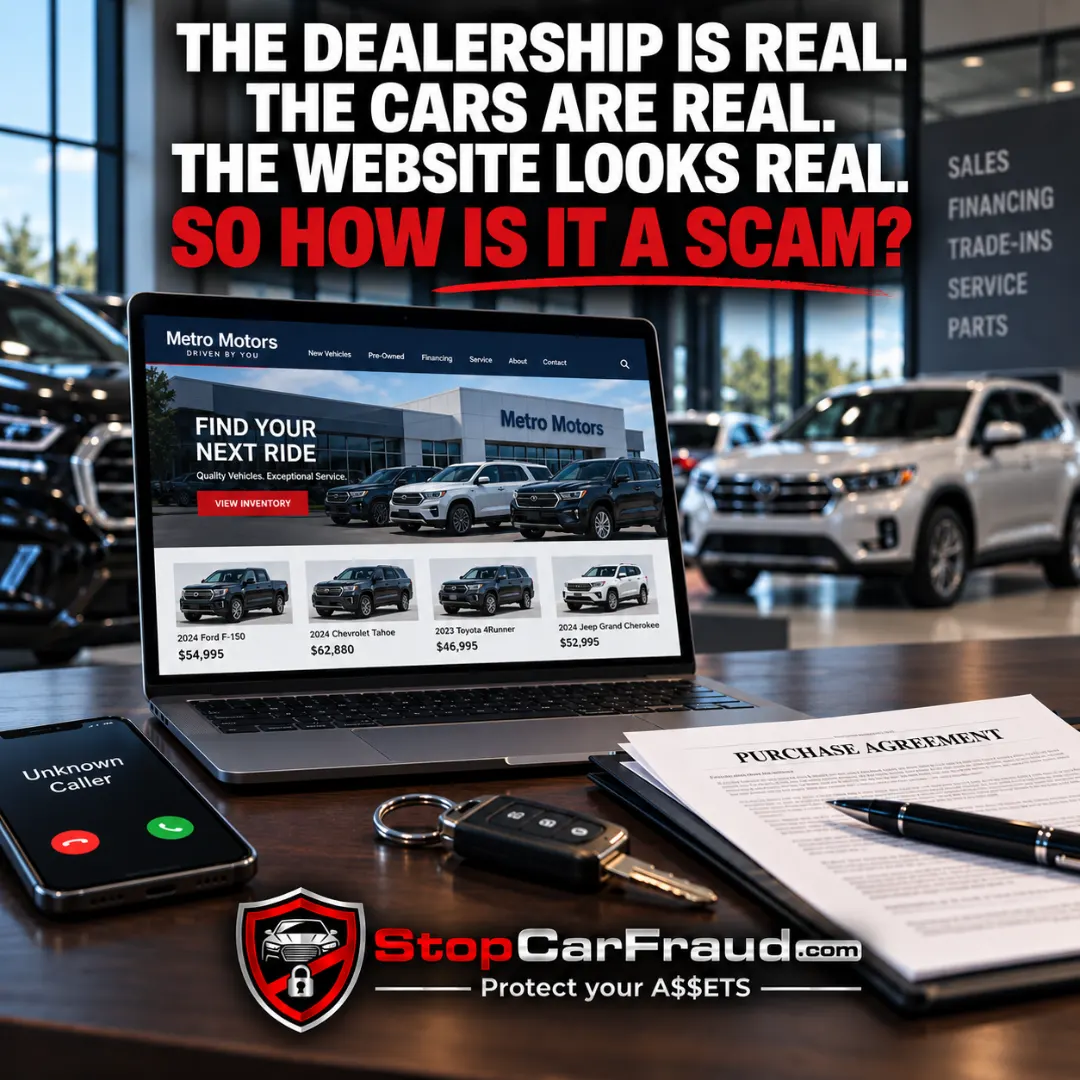
Welcome to a New StopCarFraud Series on the Fake Dealership Scam That Could Cost Buyers Thousands
Imagine finding the vehicle you've been hunting for online. The dealership has a professional website. The inventory looks legitimate. There are photos, vehicle descriptions, a recognizable dealership name and maybe even glowing customer testimonials.
You do your homework and confirm the dealership really exists, so everything seems legitimate and you send the money. There's just one enormous problem: the dealership may be real, but the person you just paid isn't.
You weren't dealing with the dealership.
The Federal Trade Commission issued a consumer alert on September 1, 2026, warning about scammers impersonating legitimate automobile dealerships online. This is exactly the kind of evolving automotive fraud StopCarFraud believes consumers and dealers need to understand, so we're breaking it down in a new series examining how fake dealership scams work, why they can be incredibly convincing and how buyers can protect themselves before money changes hands.
THIS ISN'T A FAKE DEALER. IT'S A STOLEN IDENTITY.
That's what makes this scam particularly dangerous.
A criminal doesn't necessarily have to invent "Bob's Discount Luxury Motors" and hope somebody believes it exists. Instead, scammers can impersonate an established dealership and build an online presence designed to look like the real business.
That can include appropriating dealership branding, vehicle listings and other legitimate-looking information. The FTC has also warned that artificial intelligence can make creating convincing imitation websites easier.
Think about what this does to the average buyer's fraud radar. Everything they normally check may appear to pass the test:
- Search the dealership name? It's real.
- Verify the address? There's a real dealership there.
- Recognize the logo and branding? They're legitimate.
- Search for the advertised vehicle? The car may actually exist.
- Look up the VIN or vehicle details? Those may be real, too.
A buyer can verify multiple pieces of legitimate information and still miss the one verification that matters most: Are you actually communicating with the real dealership — and are you sending your money to the real dealership?
Who are you actually communicating with?
A REAL VIN DOESN'T MAKE THE PERSON SELLING THE CAR REAL
This is where online vehicle shopping can become especially vulnerable. Photos and vehicle information appearing legitimate shouldn't automatically be treated as proof that the person behind a website, email address or phone number has any authority to sell that vehicle.
A scammer impersonating a dealership doesn't need to possess the vehicle they're advertising. They simply need enough legitimate information to convince a buyer that they do. The risk becomes even greater when the vehicle is rare, specialized or difficult to find, because excitement can quickly create urgency. Instead of questioning why a seller needs money immediately, the buyer starts worrying that someone else will grab the vehicle first. That's precisely when slowing down and independently verifying the seller becomes most important.
BEFORE YOU SEND MONEY, VERIFY THE DEALER INDEPENDENTLY
Don't rely solely on contact information provided through the website, advertisement, email or salesperson you're already communicating with.
Independently locate the dealership's established contact information and confirm that the vehicle, salesperson and transaction are legitimate. Whenever practical, physically inspect the vehicle. If distance makes that impossible, consider arranging an independent inspection rather than relying entirely on information supplied by the seller.
Be especially cautious when a seller pressures you to send money immediately, particularly through a payment method that may be difficult or impossible to recover. A professional-looking website doesn't prove the seller owns the vehicle, a familiar dealership logo doesn't prove who you're communicating with, and a legitimate vehicle listing doesn't prove the person asking for your money has any authority to sell it. In a scam built around stolen credibility, looking legitimate is the entire point.
In 2026, "it looked legitimate" simply isn't enough.
COMING NEXT IN THE STOPCARFRAUD SERIES
SCAMMERS ARE STEALING REAL DEALER INVENTORY — AND SELLING CARS THEY DON'T OWN
We'll look at one of the most disturbing parts of this scam: how authentic vehicle photos, listings and identifying information can actually make fraudulent sales more believable.
If something about a dealership, vehicle, lien, paperwork or automotive transaction doesn't add up, stop before sending money. Contact StopCarFraud at info@stopcarfraud.com and take the time to determine exactly who you're dealing with.
RESEARCH SOURCES / FOOTNOTES
1. Federal Trade Commission — “Scammers are spoofing car dealership websites: What you need to know” — September 1, 2026
2. Car Dealership Guy News — “FTC issues alert on scammers spoofing dealers' sites” — September 1, 2026
https://news.dealershipguy.com/p/ftc-issues-alert-on-scammers-spoofing-dealers-sites-2026-09-01