

THE BUYER DOESN'T EXIST!
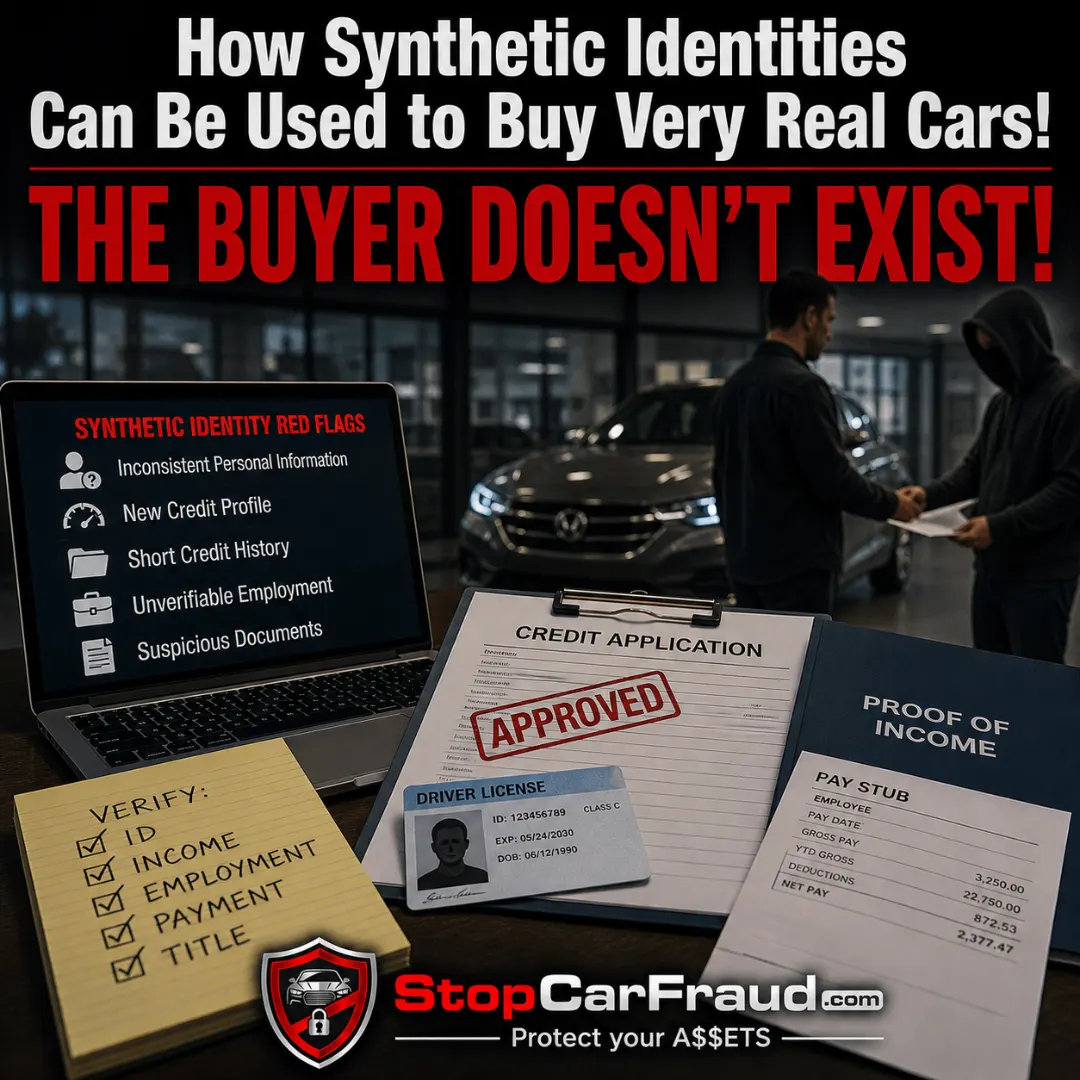
In Part 1 of our StopCarFraud series, “Old-School Auto Fraud vs. 2026 Auto Fraud,” we looked at how automotive fraud has evolved. The old tricks—stolen IDs, forged signatures, altered titles, fake pay stubs and bad checks—haven't disappeared. They've simply been joined by a much more sophisticated generation of scams powered by digital manipulation, artificial intelligence and identities that may have been carefully constructed to look legitimate.
Now we're digging into one of the most disturbing examples: synthetic identity fraud. For vehicle sellers in particular, this deserves attention because the buyer standing in front of you may appear completely legitimate. They may have identification, employment information, a credit history and supporting documents that all seem to tell the same story. The problem is that parts of that story—and potentially the identity itself—may have been manufactured.
This Is Not Your Old-School Stolen Identity
Traditional identity theft usually involves a criminal stealing another person's information and pretending to be that individual. Synthetic identity fraud can be considerably more complicated because real information may be combined with fabricated information to construct an identity that appears credible.
What makes the scheme particularly dangerous is that sophisticated fraudsters don't necessarily need to use the identity immediately. A financial footprint can be developed over time. Accounts and credit activity can help create the appearance of legitimacy before the identity is eventually used in a much larger transaction. By the time someone attempts to obtain an expensive vehicle, what you're seeing may not resemble a hastily assembled fake.
WHAT LOOKS REAL VS. WHAT NEEDS VERIFICATION
| WHAT YOU SEE | WHAT YOU ACTUALLY NEED TO KNOW |
|---|---|
Driver's license looks legitimate |
Does it truly identify the buyer? |
Credit profile exists |
Was the profile legitimately established? |
Employment information is provided |
Can the information be independently confirmed? |
Documents contain matching information |
Are the documents themselves authentic? |
Buyer appears professional and prepared |
Does the identity withstand verification? |
Payment appears successful |
Has the money actually cleared and become secure? |
AI Makes "Looks Legitimate" Almost Meaningless
This is where Part 2 connects directly to the warning in Part 1. Technology has dramatically improved the quality and consistency of fraudulent materials. Documents can be digitally manipulated, and AI- assisted tools can make it easier to produce convincing supporting information.
For years, consumers were taught to look for obvious signs of fraud: misspelled words, strange fonts, mismatched addresses, blurry logos, questionable signatures or amateur-looking paperwork. Those are still warning signs, but they cannot be your entire fraud-detection strategy anymore. A document doesn't become legitimate simply because it looks professional, and matching information across several documents doesn't automatically mean the information is true.
That's the real danger of modern auto fraud: the scam may look considerably better than the scams we're accustomed to spotting.
Private Sellers Have Something Worth Stealing
Synthetic identity fraud may sound like a problem for banks, dealerships and finance companies, but private sellers shouldn't tune out. If you're selling a $30,000, $50,000 or $70,000 vehicle, you're transferring a valuable asset to someone you probably met very recently.
Pay attention to inconsistencies, unusual urgency, unexplained third parties and sudden changes in payment arrangements. More importantly, don't rely on personality or appearances. A friendly buyer can commit fraud. A professional-looking document can be fraudulent. A payment screenshot doesn't necessarily mean usable money is safely in your account.
Before the title, keys and vehicle leave your possession, you need confidence in both the buyer's identity and the payment. Once the vehicle disappears, figuring out who actually took it can become a much bigger problem.
In Part 1, we warned that the scammers multiplied and got a lot smarter. Part 2 demonstrates why verification has become so important. Modern fraud isn't necessarily designed to look suspicious. It's designed to look legitimate long enough for you to complete the transaction.
COMING IN PART 3:
THE DOCUMENT LOOKS PERFECT. THAT'S THE PROBLEM.
How AI Is Making Fraudulent Auto Documents Harder to Spot
If you're buying or selling a vehicle and something about the identity, ownership, payment, title, lien or paperwork doesn't add up, don't risk thousands of dollars hoping everything works out.
CONTACT STOPCARFRAUD.com BEFORE YOU COMPLETE THE TRANSACTION.
Verify the person. Verify the payment. Protect your vehicle. Protect your A$$ETS.