

You Finally Found the Car You've Been Hunting For. Now You're Being Told to Send a Deposit Before Someone Else Gets It. That's When You Need to Slow Down.
PART 3 OF THE STOPCARFRAUD FAKE DEALERSHIP SERIES
You've been searching for months for a particular vehicle. Maybe it's a rare performance car, a specific classic, a hard-to-find truck, a discontinued model or simply the exact year, color and options you've been unable to find anywhere else. Then suddenly, there it is. The photos look legitimate, the dealership exists, the vehicle information appears to check out and the price isn't so ridiculously low that it immediately screams scam.
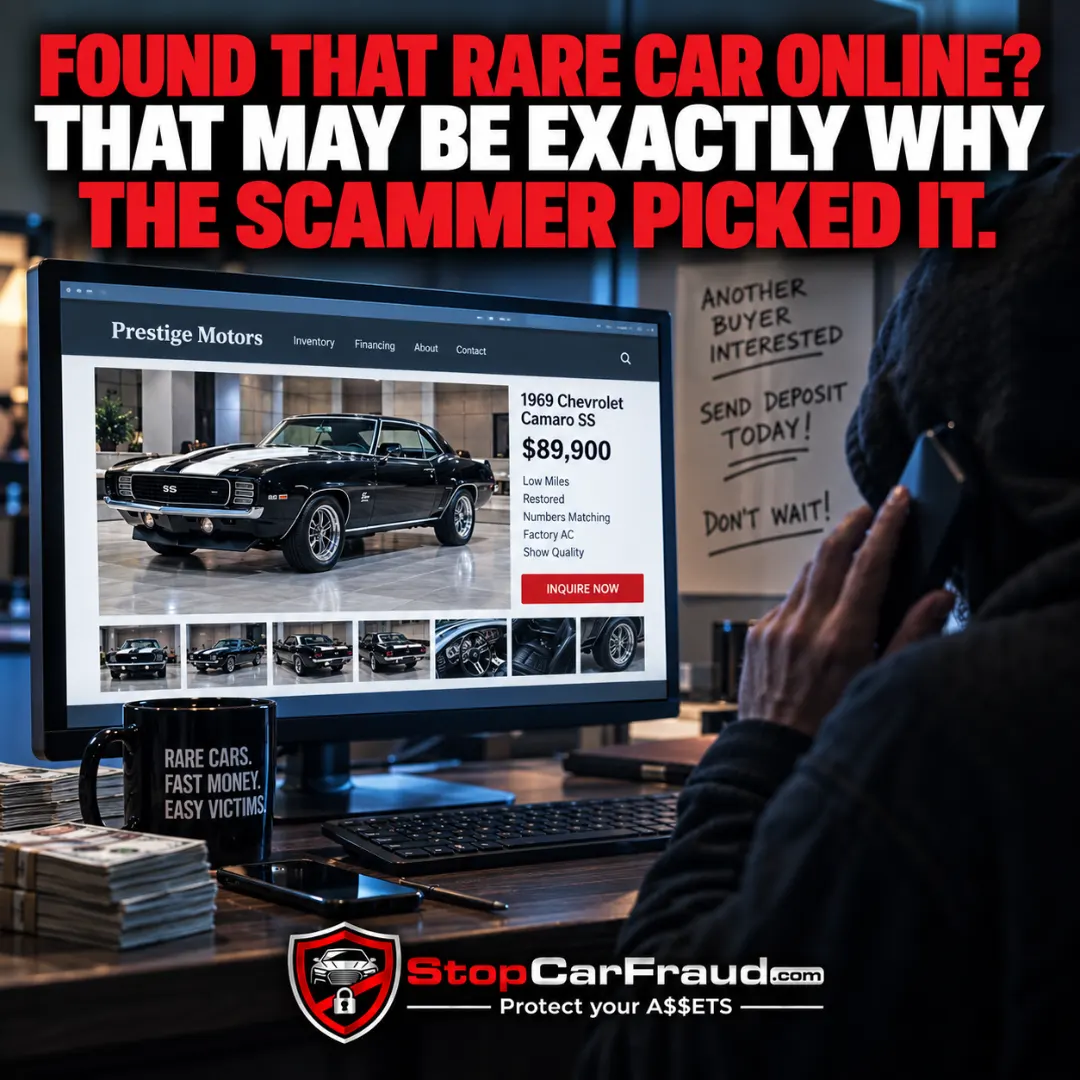
You contact the seller, and that's when the pressure begins. You're told another buyer is interested, the vehicle probably won't last through the weekend or a deposit is needed immediately to hold it. What started as a careful vehicle search has suddenly become a race to get your money sent before somebody else gets "your" car.
That urgency can be exactly what a scammer is counting on.
SCARCITY CAN TURN A CAREFUL BUYER INTO A RUSHED BUYER
The Federal Trade Commission's September 2026 warning about scammers impersonating legitimate automobile dealerships specifically discusses consumers searching online for rare and hard-to-find vehicles. These vehicles can make particularly effective bait because buyers already know they may not get another opportunity anytime soon.
Walk away from an ordinary used SUV and there may be dozens more available within driving distance. Walk away from the collector car, limited-production model or specialty truck you've spent eight months trying to find, and it can feel like you're giving up your only chance.
That's when emotion can begin replacing normal caution. A scammer doesn't necessarily have to convince a buyer to ignore an obvious warning sign. Creating enough urgency that the buyer believes there isn't time to investigate can accomplish the same thing.
THE VEHICLE MAY ACTUALLY EXIST
As we explained in Part 2 of this StopCarFraud series, criminals impersonating dealerships may use information taken from legitimate businesses and real vehicle listings. That means the photographs you're looking at may be genuine, the dealership name may belong to a real business and the vehicle itself may actually exist.
Combine that credibility with scarcity and the situation becomes much more dangerous. A buyer sees professional photographs, legitimate-looking vehicle details and a real dealership name while simultaneously being told another customer is ready to buy. Suddenly, sending a deposit can feel less like taking a risk and more like protecting an opportunity.
But there is one critical distinction: proving that the vehicle exists does not prove that the person asking for your money has any authority to sell it.
"SOMEONE ELSE WANTS IT" DOESN'T MEAN STOP VERIFYING
Desirable vehicles really do sell quickly, and a legitimate dealership telling a customer that another buyer is interested isn't automatically evidence of fraud. The warning sign is when urgency starts interfering with your ability to independently verify the transaction.
If you're discouraged from calling the dealership through an independently located phone number, confirming the salesperson's identity, arranging an inspection or verifying payment instructions, don't allow fear of losing the vehicle to override those concerns. A legitimate transaction should withstand legitimate questions.
Pay particular attention if the seller becomes evasive, aggressive or suddenly creates obstacles when you try to verify information outside of the website, email, text messages or phone number they provided.
DON'T LET THE SCAMMER CONTROL THE VERIFICATION
Before sending a deposit or full payment, independently locate established contact information for the dealership and contact the business directly. Confirm that the vehicle is actually available, verify that the salesperson you've been communicating with works there and confirm where the dealership expects payment to be sent.
If you're purchasing from another state and can't personally inspect the vehicle, consider arranging an independent inspection. Most importantly, don't let artificial urgency dictate when verification ends and payment begins.
Losing a rare vehicle to another legitimate buyer is frustrating. Losing thousands of dollars to a criminal selling a vehicle they never owned is considerably worse.
COMING NEXT — PART 4
THE WEBSITE LOOKS LEGIT. THE DEALERSHIP EXISTS. NOW PROVE WHO YOU'RE ACTUALLY TALKING TO.
Next, StopCarFraud will break down how buyers can independently verify the dealership, salesperson, vehicle and payment instructions without accidentally using information supplied by the scammer to verify the scammer.
If something about a dealership, vehicle, paperwork or automotive transaction doesn't add up, stop before sending money and contact StopCarFraud at info@stopcarfraud.com.
RESEARCH SOURCES / FOOTNOTES
1. Federal Trade Commission — Scammers Are Spoofing Car Dealership Websites: What You Need to Know — September 1, 2026
2. Car Dealership Guy News — FTC Issues Alert on Scammers Spoofing Dealers' Sites — September 1, 2026
https://news.dealershipguy.com/p/ftc-issues-alert-on-scammers-spoofing-dealers-sites-2026-09-01