

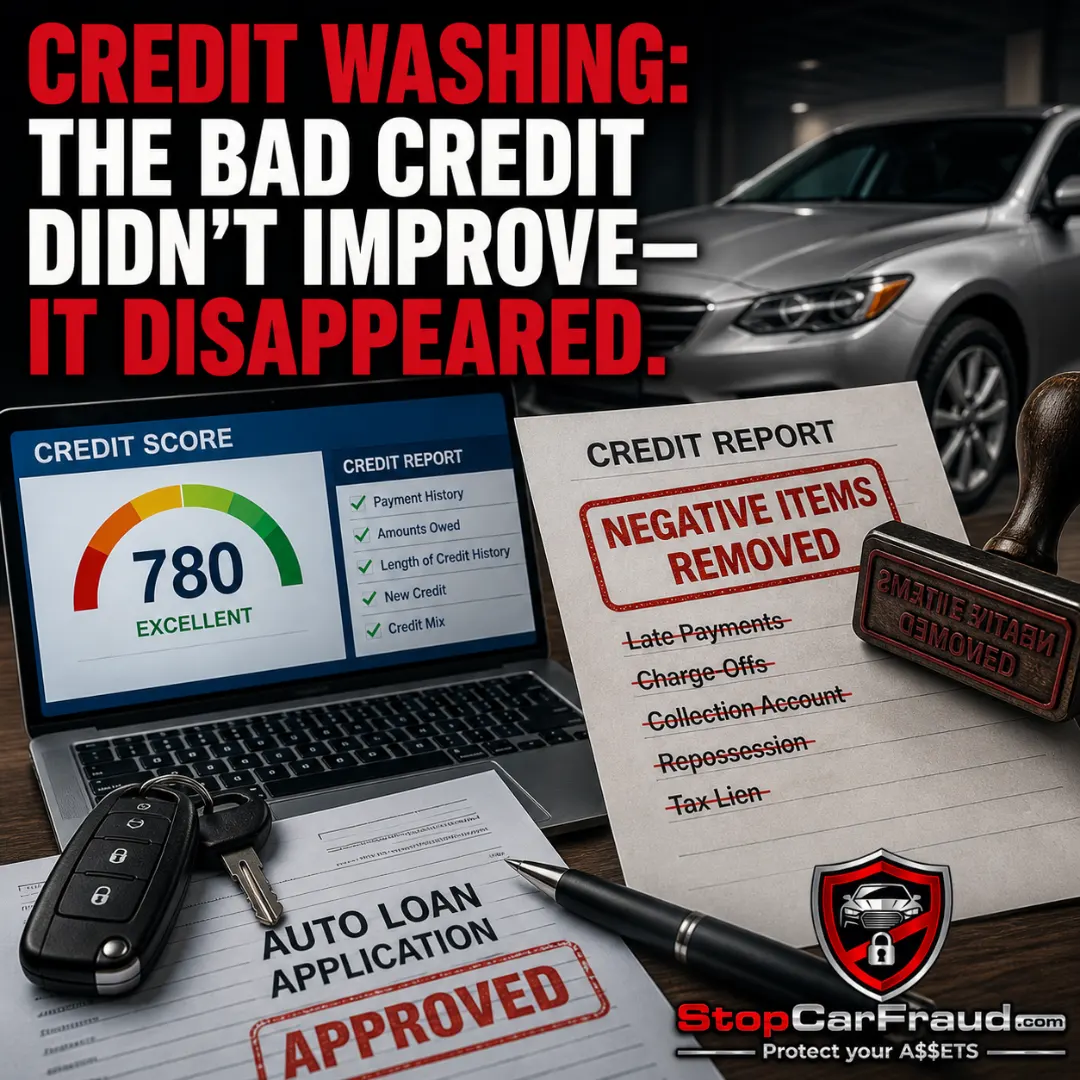
There was a time when improving bad credit was painfully boring. Pay bills on time. Reduce balances. Stop missing payments. Wait for negative information to age. Repeat.
Credit washing offers a much faster alternative: make the bad information disappear.
And in 2026, the auto lending industry is paying much closer attention to it.
Credit washing generally involves disputing legitimate negative information on a credit report in an effort to have that information removed or suppressed. A borrower who previously appeared risky can suddenly look considerably more creditworthy without actually changing the financial behavior that created the bad credit in the first place.
That difference matters when someone is trying to finance a vehicle.
From Credit Repair Trick To AI-Assisted Fraud
Consumers absolutely have the right to dispute credit information that is inaccurate or doesn't belong to them. A legitimate dispute is not credit washing. The problem begins when accurate negative information is deliberately challenged in an effort to manipulate the credit file.
Point Predictive's 2026 fraud intelligence research identifies AI-assisted credit washing as a growing auto-lending threat. According to its consortium data, credit-washing alerts increased approximately fivefold from 2019 to their 2024 peak, when alerts appeared on 1.7% of auto applications. The rate remained elevated at 1.54% in 2025.
CREDIT WASHING ALERT RATE
Share of Auto Applications
| Year | Alert Rate |
|---|---|
| 2019 | 0.34% |
| 2020 | 0.39% |
| 2021 | 0.30% |
| 2022 | 0.50% |
| 2023 | 0.65% |
| 2024 | 1.70% |
| 2025 | 1.54% |
Source: Point Predictive, 2026 Fraud Risk Intelligence / Auto Lending Fraud Trends research.
The numbers show why this deserves attention. This isn't a sudden one-month spike. The alert rate accelerated substantially over several years and remains far above where it began.
Artificial intelligence adds another layer to the problem. AI tools can help produce dispute letters and supporting documentation quickly and at scale. What once required someone to individually create disputes can increasingly be automated and repeated.
In other words, an old trick has been handed much better technology.
The Credit Score May Improve. The Risk Didn't.
This is where credit washing becomes especially concerning for auto lenders and dealers.
A July 2026 TransUnion analysis found that consumers with suppressed negative credit information can appear to qualify within prime or higher credit tiers even though their subsequent repayment behavior can resemble borrowers in much riskier categories.
Among 2024 auto originations, for example, TransUnion found a 5.6% subsequent 12-month charge-off rate among credit washers classified as prime, compared with 1.2% among other prime consumers. That's the problem in one comparison: the credit profile may have changed dramatically while the underlying borrower risk did not.
Why This Fraud Can Be Difficult To Spot
Credit washing doesn't necessarily require a stolen identity.
The applicant may be using a real name, legitimate Social Security number and valid driver's license.
Traditional identity verification may therefore work exactly as intended.
It's the credit history attached to that person that may have been manipulated. Potential warning signs can include a sharp credit-score increase shortly before an auto-loan application, multiple derogatory accounts disappearing within a short period or an unusual burst of disputes.
No single change proves fraud. Consumers legitimately correct inaccurate credit reports every day. But a combination of unusual changes may deserve additional scrutiny before a vehicle and thousands of dollars in financing leave the dealership.
AI Is Changing An Old Fraud Problem
Credit washing is part of a much larger shift occurring in automotive fraud.
Point Predictive estimates overall auto-lending fraud exposure reached $10.4 billion in 2025 and identifies credit washing alongside income and employment misrepresentation, synthetic identities, bust- out schemes and AI-generated documentation among the threats facing lenders.
For dealers, lenders and others involved in vehicle transactions, the takeaway is straightforward:
A clean credit report isn't necessarily proof of a clean credit history.
Technology is making fraud faster, more scalable and, in some cases, much harder to recognize before the transaction is completed.
If you are unsure about a lien release, vehicle transaction, suspicious buyer, questionable documentation or possible automotive fraud, contact StopCarFraud at info@stopcarfraud.com. It is far better to investigate the warning signs before the vehicle and the money are gone!
Sources & Further Reading
1. Point Predictive — Q2 2026 Fraud Risk Intelligence: Credit Washing
https://landing.pointpredictive.com/fraud-risk-intelligence-q2-2026
2. TransUnion — Auto Loan Fraud Losses More Than Triple in Key Categories — July 23, 2026
https://newsroom.transunion.com/auto-loan-fraud-losses-more-than-triple-in-key-categories-new-
transunion-analysis-finds/
3. TransUnion — The Dirt on Credit Washing
https://www.transunion.com/insight-guide/dirt-on-credit-washing
4. Consumer Data Industry Association — Credit Washing, Disputes and Fraud — August 10, 2026
https://www.cdiaonline.org/events/2026/08/10/credit-washing-disputes-and-fraud-what-you-need-to-
know-in-our-upcoming-webinar/
5. Point Predictive — 2026 Auto Lending Fraud Trends Report
https://landing.pointpredictive.com/2026-fraud-trends-report